The Road to the Future
Dublin Core
Title
The Road to the Future
Description
The closing address of the Kensington "The Re-Emergence of the Goddess" conference (1979), delivered by Sr. Angelina.
Creator
Sr. Angelina
Source
Personal collection of David Kay.
Publisher
Madrian Literature Circle
Date
1979
Language
English
Type
Text
Text Item Type Metadata
Text
[In Mr David Kay's handwriting].
The Road to the Future
(The closing address, given by Sister Angelina, at the conference entitled "The Re-Emergence of the Goddess at Kensington, [London, Britain] Maia [April 18th - May 15th] 5080 [1979])
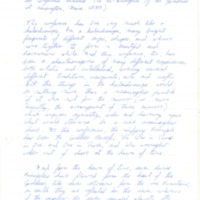
This conference has been very much like a kaleidoscope. In a kaleidoscope, many bright fragments of different sizes, shapes and colours come together to form a beautiful and harmonious whole. And this conference, too, has been a phantasmagoria of many different experiences, both artistic and intellectual, covering several different traditions, viewpoints, arts and crafts. But the things in the kaleidoscope would be nothing more than a meaningless jumble if it were not for the mirror (or more exactly, the arrangement of three
mirrors) which impress symmetry, order and harmony upon what would otherwise be a mere meaningless chaos. At this conference, the unifying Principle has been the Goddess Herself; She Who is Three in One and One in Threes, and Who wrought order out of chaos at the dawn of time.
And from the dawn of time, seven divine Principles have flowed from the heart of the Goddess, like seven streams, from the one fountain; on earth they are reflected in the seven colours of the rainbow, the seven sacred planets, the seven ancient metals, the seven notes of the musical scale and a hundred other sacred sevens. And one of those Principles is Order. In Madrian tradition we call her by the name of Themis. The seasons come and pass in their appointed rhythm; and for those who can see beyond the outward show, a sacred dance is being performed, a ritual drama enacted before our eyes. Each flower, each tree, each snowflake and each crystal develops in perfect accordance with a divine pattern so intricate and is perfect that it is at once more beautiful than any work of art and more complex than the American space programme.
And it is this same law, this same pattern, this same themis, to which in any normal society, all the activities of maid are attuned (and maid, of course, embraces man). All of her arts, all her crafts, the way she builds her house, the way she tills the soil, the way she weaves her clothes: none of these things is done haphazardly or at random, any more than a crystal is formed at random. Neither is it done simply in the quickest, cheapest or most efficient way, as it is in an abnormal society like our own. It is done according to a ritual pattern laid down from time immemorial. Why is this so? I think those present who have some understanding of the principles of magic (I think they are a majority) will readily understand why. For they will know that a properly conducted ritual is not simply a game, but something that has a very defina[i]te effect. Imagine, then, the force of a ritual performed not just by a handful of people in a room or a forest for an hour or so, perhaps once in a month; but performed by an entire society for most of the waking life of all its members, over a period of thousands upon thousands of years. And remember that when we speak of a society here, we are not referring to a town or a village, or even to a country, but to the whole world, for the religion of the Goddess was the faith of every part of the globe up until a few thousand years ago.
And what was the purpose of this ritual? It was not, for the most part, to attain any material goal, but to bind every soul to She Who has created her; to God Herself. Beyond that its purpose was the same as the rhythm of the seasons, and every natural pattern: to show forth the divine drama; to unite every creature in the dance of the love of the Goddess. For love and harmony and order are one. I would like to read you some words from the book of the Crystal Tablet:*
[33] " It is Love that holds the drop of dew penda[e]nt upon a blade of grass, neither flowing forth in watery profusion, but swelling within the unseen urn of its brief harmony.
[34] " It is Love that holds the stars within their courses, and all the worlds of the immeasurable cosmos within the harmony of the celestial music.
[35] " Truly, all the cycles of the times and the seasons; all the rhythms of the soul and of the mind and of the body: truly, all these flow from the love of our Lady, the Maid, that creation may not decompose, each several member flying away into black eternal chaos."
It has been said that the function of a conference is not so much to answer questions as to ask them. And one question before all others has implicitly been asked by the whole of this conference. Not only by the things that have been said and done, but by the very fact that it has taken place at all. That question, put in its simplest form, is: where are we going? Where lies the road to the future?
For this conference is more than just an isolated event; it is a symptom. It is a symptom of a very real change that is taking place in the thinking and feeling of many of the most sensitive people in our time; a symptom of a subtle but very defina[i]te shift in the spiritual aethyr which surrounds and interpenetrates our physical world. A conference of adult maids and men meeting together in the fourth quarter of the twentieth century to discuss the Goddess. Of course, it happened last year in California, but then California is California. Anything can happen in California. But in Kensington? [London, Britain] Ten years ago it would have been impossible. Five years ago it would have been wildly improbable. Today it has happened. In its way it is a landmark, and it is defina[i]tely part of a pattern. I would like to relate a few incidents which make clear the nature of that pattern.
A little over three years ago, I was part of a group of traditional Madrians living partly near Oxford and partly around the Kentish Coast. The members of this group were thinking and talking about taking the unprecedented step of bringing their religion out into the open, and giving those who had not been brought up in traditional Madrian homes the opportunity of becoming a part of the religion of the Goddess. It is difficult to appreciate what a tremendous step this was if you have never experienced the life of the traditional Madrian community. The beliefs and customs of the faith have been passed down from mother to children for centuries in the strictest secrecy. The whole life of the community is governed by traditional ritual and custom. To do anything which breaks with tradition is something almost unheard of. Now please don't misunderstand me; I am not criticising this attitude in the smallest degree. I know only too well that the value and power of tradition is something infinitely deeper and more mysterious then the profane world can possibly understand. But we believed not only that this was not so much a break with tradition as a return to a deeper and more ancient tradition. After all, the religion of the Goddess has not always been secret by any means. For most of the history of the human race it has been not only open, but the universal religion of the whole world. Also, we believed that what we were doing was in accordance with a new pattern which was about to emerge in the course of human history. That is why we called our magazine The Coming Age. In fact, subsequent events only too neatly served to confirm the pattern.
Traditional Madrians have very little contact with the mass-media, so I don't think any of us at that time were aware that a book by Elizabeth Gould Davis entitled The First Sex was sweeping through the women's liberation movement in America and creating radical changes in the thinking of many maids and men who had not previously thought of themselves as feminists. Or that the paperback edition was already beginning to make an impact in this country. [Penguin Books, London UK (1973)]. This book marshal[l]s a vast array of evidence, arch[a]eological, anthropological and historical, to establish three facts beyond reasonable doubt: firstly that human civilisation, in the form of civilised and cultured communities had been in existence for tens of thousands of years before the rise of the patriarchal cultures of the last four or five millen[n]ia; secondly, that these older civilisations were matriarchal - that maids were the heads of households and priestess - queens, rather than warrior kings, the heads of state; thirdly, that almost without exception, all these matriarchal civilisations, in China, in Europe, in the Middle East, in India, in the Americas, worshipped a supreme God, and that She was invariably depicted as female.
Of course, this was very far from being new. Apart from Madrian traditions, people had been saying this for over a century, from J. J. Bachofen to Robert Graves (in fact Elizabeth was a close friend of Robert Graves). And the information has always been there in the ancient writers, such as Herodotus, for those who cared to read it. She certainly added some more up-to-date evidence to clinch the case - such as the findings of the Catal Huyuk excavation of the early sixties. But the real importance of the [book] was its impact. For years the facts about matriarchy had been told, but nobody had listened. Now it seemed that they were emerging from the category of forgotten facts, known by the few and ignored by the many. Matriarchy was an idea whose time was coming. In the next few years, of course, we witnessed a tremendous upsurge of interest in matriarchy and the religion of the Goddess. A number of books were published and organisations founded within a short time of each other, all of which were the result of long thought and preparation. To a large extent, this conference is a result of those years of activity. The fascinating thing is that for several years a number of different people, with no contact between them, were all working and thinking along the same lines at the same time. It is beyond the bounds of coincidence. Something important was happening. After centuries of suppression, the world's first religion was preparing to break in again upon the consciousness of the world. I am not saying that everyone involved in this large and rather amorphous movement was aware of what was going on. Probably not. But the movement was far greater than the sum total of individuals who made it up. We are living in one of those rare moments in history when Eternity touches time, and where the seeds of deep and mysterious changes take route [root] in the soil of human destiny.
The essence of these changes was neatly summed up by the writer and journalist Stewart Farrar: *2
"...the readmission of the Goddess to Her proper place in the minds of men and women is probably the most significant relig[i]ous development of modern times. I will risk a prophecy, because I profoundly believe that it will prove to be true: that over the coming centuries (or even decades), it will be at Her shrines, increasingly and predominantly, that the mass of humanity will worship."
If this [this] is true, why is it true? I think the answer takes us back to the question of themis, order or harmony. I don't think anyone can be unaware today that man (and I use the word advisedly) is flouting the laws of nature to a degree which puts the entire future of the human race in doubt. Natural resources are wantonly wasted; the environment is polluted; nightmarish weapons are created. On a more subtle but no less important leva[e]l, the spiritual environment is being equally polluted. Polluted by making the majority of people do work which has no spiritual meaning, unlike the traditional crafts. By undermining the faith in spiritual and supernatural realities by a shallow and vulgar materialistic pseudo-philosophy incalculated compulsorily by the education system and semi-compulsorily by the mass-media.
A friend of mine is an avid reader of children's comics. One of the current stories, set a few decades in the future, depicts a time when there are no more trees or grass, when the parks are stocked with plastic replicas of plants. Where the entire landscape is nothing more than an endless concrete ant-heap broken by a few pseudo-parks. The vision is a horrifying one; but one has only to pause for a moment to see it is no more horrifying, and probably rather less so, than our own cities - and, indeed our industrialised agriculture - would seem to a visitor from a natural society. In that world the people revolt; and in this world too the first signs of revolt are manifesting themselves. On the physical level through ecological, self-sufficiency and similar movements. On the spiritual level by a widespread movement toward exploring spiritual realities.
I do not think the return to the Goddess is a part of this movement, I think it is the very heart of it. Everything that is wrong with this world springs from a rupture in the divine order, in the natural themis of human life. And that rupture is not new; it started a very long time ago. It started when the first warrior king usurped the throne of the first priestess-queen, and when the worship of the female God of love and harmony was overthrown by the idolatry of the male god of wrath and war. The real disease of the modern world is not physical but spiritual, as Theodore Koszak has put it:
"What, after all, is the ecological crisis which now captures so much belated attention but the inevitable extro[a]version of a blighted p[s]yche? Like inside, like outside. In the eleventh hour, the very physical environment suddenly looms up before us as the outward mirror of our inner condition, for many the first discerna[i]ble symptom of advanced disease within." *3
If we want to cure the disease, we cannot simply concentrate upon the external symptoms, we must get down to the spiritual roots. The fundamental problem is disorder. Matriarchy used to be called chrysothemis: "the golden order", because the Goddess, as we have seen, is the very principle of order, and the order of society which She has ordained is necessarily the perfect order. When we look at the world without the Goddess we see chaos. Because to look at the world without the Goddess is like looking through a kaleidoscope without the mirrors. We see a jumble of physical facts which have neither beauty nor transcenda[e]nt meaning. This is the materialist view of the world, and it cannot do anything except produce a world which lacks beauty and meaning. It has to produce ugly cities and despoil nature because it cannot understand beauty. It has to create spiritually useless work, because it does not know the spiritual meaning of the world. All it can see is a chaotic jumble of physical "things", and all it can ask is "how can we get as much out of them as possible". Even the animals are treated as "things". We all know about the way hens and calves are treated on factory farms. I won't go into the sort of torture they practice in vivisection laboratories, because we have just eaten.
This sort of thing is inevitable, and it will get worse, so long as society continues to turn its back on the Goddess. Everything that is good, everything that is humane, everything that is beautiful in the modern world is what we call a legacy; a fund of spiritual capital left over from the time when the whole world worshipped the Goddess. And that capital is running out rapidly. There is only one possible solution, and that is to turn back to the Source, the single Fountainhead of grace, Who is the Goddess. If we do not do that, then all the ecological, political and other measures taken to ease the situation will be like so much straw stuffed into the cracks in a bursting dam.
Every action and every thought is a ritual. And when we see matter without Spirit, the world without the Goddess, the fragments without their unifying Principle; and when we act out this vision as if it were true, which is what the whole of modern society is all about; then things really start becoming disconnected fragments; the world starts to fall apart, both the outer world of the environment, and the inner world of our own souls. The ancient arts and crafts and all the ancient wisdom was a sort of white magic devoted to unifying the world with God and with itself. Modern industry and all the false teachings of modern materialism are a sort of black magic, which has the effect of breaking up and fragmenting the world.
I have said that the spiritual capital which we have borrowed from our matriarchal past is rapidly running out. One very good example of this concerns Tibet. Tibet was perhaps the last country of any size upon this earth whose whole way of life was based around spiritual principles. This was largely due to the fact that although on the surface she had been patriarchalised, she
retained to a very large extent her matriarchal heritage. The Goddess, under the name of Tara, was the most powerful religious influence in the country. To quote from Dr. Beyar's The Cult of Tara: *4
"Tara is the principle superhuman being in Tibet who might be called divine without further qualification. She is prayed to by millions. Her help in adversity is divine.
"...It does not help much to search for "causes" to explain this trust in Tara and her eternity... She was real, she was divine. Tara was, had always been, and still is the almighty support of her devotees who address her. In fact she is mightier than Buddhas and Bodhisattvas... To understand something of her cult is to understand something of the mainstay of Tibetan culture."
In the country regions of Tibet, a more or less matriarchal structure existed right up until the turn of the century. Savage Landor, who travelled there reported that:
"The Tibetan woman is far superior to the man, never shy; while the men ran away or hid from foreigners, the women always received them with dignity, speaking fluently."*5
"In that country, the women are the mistress of the house, the men live in dependency upon them, show them great respect, and treat them with such affection and submissiveness that nothing is undertaken without their consent." *6
As well as a general level of spiritual advancement unparalleled by any other nation in this century, Tibet was also renowned for her respect for nature and compassion toward the animal realm. Of course, the ancient priestess - queens had not reigned for many years and a male dominated Buddhism was the official religion. Very slowly, a decadence was [was] setting in deeper and deeper. But still the ritual power of that country and its way of life was a profound force for good in the world; helping to hold at bay the forces of the final disintegration. Now that country has been ravaged and its traditions demolished by the military force of a China enflamed by Western materialist ideology.
We should not be surprised at this, for all traditional teaching, in contradiction to the modern creed of "progress", teaches that each succeeding age within the historical cycle will be darker than the one before it. At the beginning of the last and darkest age, Kali Yuga, or the Age of Iron, which began some 5,000 years ago, first matriarchy was slowly undermined, and the religion of the Goddess corrupted by alien cults and practices, then the ancient faith was supplanted by new invented cults. Each of these new religions contained something of the ancient truth, but slowly, as the age progressed, that truth became more and more diluted and corrupted. New cults sprang up as old ones decayed, each containing less of the truth to begin with and succumbing more quickly to corruption. Now we stand at the end of the age, when ignorance, or blindness to spiritual Reality reaches its point of greatest extension, and when Truth is at its lowest ebb. Yet when the dark age ends, it must be followed by a new Golden Age - a renewal of the chrysothemis, the Golden Order; and the seeds of this new order must already be present in the final stages of the dark age.
Whenever I am asked what is the difference between a world ordered in harmony and one which has broken away from it - I mean the really practical difference, I always have to go back to the traditional Madrian communities for an illustration. Of course, these communities cannot be anything like the Golden Order, for this is the Iron Age, but they certainly do give a picture of the difference between a people who see the kaleidoscope with the mirror and a people who see it without. And in many ways the difference is even greater than one might have thought. Many people in the modern world find Madrian ideas and doctrines very difficult to understand until they have become used to them. For their part, the members of traditional Madrian communities find the modern world almost impossible to understand. And when they do get to the bottom of a modern way of looking at something, the answer is often more puzzling than the question. Having explained a modern notion, the answer often comes in the form: "I see... really... well, I wonder whatever possesses then to think [think] that." The difference is, of course, that the modern world sees things - anything, from grass to carpentry, from seals to stars, from myths to maths, in terms of physical facts, while the traditional view sees them in terms of the spiritual cause which underlies them.
We may use an image to understand this. Imagine a big, old-fashioned cartwheel. The hub represents Spirit, from which all the manifest universe pours fo[u]rth. The spokes shine forth from the hub like rays from the sun. The spokes may be taken to represent either all the different souls, or all the different things in the world. The rim of the cartwheel is the physical plane where your particular spoke touches the rim that is your body, where your particular spoke touches the hub, that is your Spirit or the Spirit. We can say either, because it is the point where "you" stop being an individual sepe[a[rate ego, and become one with the essence of all things , it is the state of oneness achieved by the heras or saints: subjectively, it can be called enlightenment; objectively, it can be called the Absolute. Both are true, because it is both subjective and objective simultaneously. It is at once the top of your individual spoke, and the centre of the wheel. It is described by Yeats:
There all the barrel-hoops are knit,
There all the serpent-tails are bit,
There all the figures converge in one,
There all the planets drop in the sun. *7
Most of us, of course, is neither body nor spirit, but soul. And we exist at once, at least potentially, on countless intermediate leva[e]ls of being between matter and spirit. You will notice by the way, that the hub is often compared to the sun. That is because the sun symbolises the Mother, Who is pure Spirit; while the moon symbolises the Daughter, who is perfect Soul, and who has broken away from the hub in order to lead us back to it. As the original doctrine became corrupted, this was misunderstood, and the Goddess was thought of as being either the moon only (as in the Graeco-Roman west), or the Sun only (as in Japan).
To return to our wheel. If the spokes are considered as "things" rather than souls, the point at which the spoke touches the hub [is] the point at which a "thing" is emanated fro[m] the Goddess as a divine Idea. The point at which the spoke touches the rim is the point at which the Idea crystallises in physical matter to form a physical object. The real essence or inner nature of the soul lies in the physical body. And like the soul, the "thing" is manifested at countless different leva[e]ls between matter and Spirit. That is why traditional peoples say that the symbolic nature of a thing is more real than its physical nature. The symbolic nature is manifested at every leva[e]l, right the way up to the hub, while the physical object only exists only at the rim. The rose, as a physical flower, exists only in the physical world, but the complex and uniquely beautiful expression of love, and of union with God the Mother, which is the inner essence of rose-ness exists at every leva[e]l of being. It exists at leva[e]ls where the experiences of redness, softness, sharpness and perfume have no meaning, but each of these qualities will have its precise equivalent, and those equivalents will be gathered together to represent at that leva[e]l the unique and universal archetype of the rose.
[Full article: Symbolism: The Wheel and the Chariot, page 18, 19, 20, issue 11 The Coming Age].
Now the historical decline, from the beginning of the Golden Age to the end of the Iron Age, may be seen as a centrifugal movement from the hub of the wheel out towards the rim. Of course, we can never quite reach the rim, for if we did, we would not see things and people at all, we would see nothing but sheer undifferentiated matter. In a sense, modern science is pushing toward this final goal when it seeks to explain everything in terms of pure quality, ignoring all their qualitative aspects, and to reduce everything to numbers. So is modern industry when it treats all people as mere numerical units, interchangeable button-pushers. In fact everything that is specifically modern is a sort of black alchemy, seeking to transmute all the remaining gold which we have inherited from our matriarchal past into iron, so that we may reach the iron hoop at the rim of the wheel. But we can never quite reach it. Or rather, we can only touch it for one brief instant of total and absolute chaos, the momentary hiatus in which the wheel stops turning, before it reverses direction, and the Golden Age is restored.
Chaos is the precise word to describe this moment, for the hub, being perfect unity, is also perfect harmony, while the rim, being the point where the spokes reach their greatest separation, is absolute discord. Similarly, the axle-point at the centre of the wheel remains still. This is absolute Deity, beyond all manifestation, the Dark Mother. The hub revolves slowly, throwing out her rays into manifestation. The spokes move more and more rapidly as they approach the rim, corresponding to the acceleration of the historical cycle as it reaches its end-point, the ever more rapid rise and fall of empires, ideas and religions, and finally the frenetic "pace of life" of the modern world, its passion for speed and change above all things. And the acceleration itself accelerates, for as the speed increases, the centrifugal pull becomes stronger.
[The following is published in one page on page 15, issue 11 The Coming Age].
Now, the whole difference between the traditional and the modern way of thinking is that the traditional order or themis looks toward the centre for the meaning of all things, while the modern mentality has been conditioned to look towards the rim. And this affects everything that each of them says, does and thinks. I say the modern mind has been conditioned, because it is not natural to look toward matter for explanations of things. When a child asks why there is a moon, she is not really satisfied with an explanation of what the moon is, in terms of physical matter. But if she goes on asking why, she will be met with something like "it just is, that's all. There isn't any why." Now to answer the child's question what, or why, is the moon, by saying that it is a piece of rock floating in space, is a bit like answering the question "why do you look so sad", by going into a long rigmarole about the chemicals in your brain and electrical impulses and so forth. In a sense it is true, but it only describes the mechanics of the thing, and doesn't really answer the question. The essential moon like the essential rose, is something far beyond its physical manifestation on this plane. And it is this essential moon that the child is instinctively after. Hammering this instinct out of her, killing her natural intuition of the spiritual nature of things: this is what is known as education.
Now when we move from the modern world, whose whole life is directed toward the rim into a traditional Madrian community, it is like stepping into another world or into another time-period. The whole of life takes on the character of a dance. There is a space and elegance about every activity which, in a way, is the exact opposite of what we call "natural behaviour". For the aim of life is not to express the outward, egoic self but to express the true Self, which is the spiritual Centre of every maid. Every individual is unique, that is why there are different arts, different crafts, different vocations; but the uniqueness of the individual is expressed through the pattern of the dance. It is not a question of everyone being very "spiritual" all the time - it is just a different way of looking at life.
In many ways, the expression of emotion is freerer [freer]. The members of the communities are quicker to laughter and to tears; they are able to throw themselves heart and soul into a festival in a way that few modern people can manage. The reason for this is that people are less self-conscious. In the modern world, people are afraid of taking anything too seriously. In Madrian communities, people are aware of being surrouned by eternal Realities. The symbol really is the thing it symbolises, on its own level. We do not say "the cartwheel is a symbol of the cosmos", we speak of "the cosmos in the likeness of a cartwheel"; and the sacred craft of the wheelwright is, in a sense more real than the untraditional mind can comprehend, a re-creation of the world - or, more exactly, a participation in the continuous creation of the world.
These are deep and complex doctrines, and there is not time to go into there her; in any case, they cannot really be understood without being experienced. But they do give a key to the life of Madrian communities today, and the seeds of the new order which is emerging from the present chaos. The head of the household is obeyed because she is, on her own level, the surrogate of the Goddess. The household revolves about her as the planets revolve about the sun, or the Geniae revolve about the Goddess. All levels of reality are brought together. In this age, of course, even the best community can be only a shadow of what things were and will be in the Golden Age.
Materialism is not merely an attitude of mind; it corresponds to a very real "hardening" or consolidation of the material environment that has been taking place over the last centuries of the iron age. The world has become in many ways a less "magical" place. The ancient writers are often thought of as naive and credulous for believing strange and wonderful tales, and even reporting such events. It is not considered that the very conditions of the terrestrial environment may have undergone changes, and that what is impossible today may not have been so many centuries ago. And since we are speaking only of the degeneration that has taken place within the latter half of the Iron Age, it will be seen that the possibilities open in the Golden Age will be immeasurably greater.
There are two possibilities before each of us. Either we lend our weight to the downward spiral, or else we help to sow the seeds of the future. If we choose the latter, the road will not be easy. We must re-think everything that we have been taught by the profane world; we must learn from the primordial tradition a Reality which lies far deeper than the "facts" of the profane world. We must not condition our children to see the pieces without the kaleidoscope. If spiritual truth is true then it affects everything. If one teaches atheist physics, history and geography, there is no point in adding a little "religious" education. Our whole view of the world must be restructured in the light of the Spirit, looking toward the hub and not the rim.
It will not be easy, and we cannot do it by ourselves. But if we turn to the Goddess in love, she will show us the way; for "it is love that holds the stars within their courses". All the physical, moral, intellectual and organisational efforts that we make toward the future; not one of them can be separated from the devotional love of the Goddess. Without that love, they will all be as nothing. With it the "impossible" will become a reality.
This conference is drawing to a close. Soon we will be going out into the world; and much of what has been said today may begin to seem "unreal". The things we hold dear, the world does not understand, and our minds are in danger of being swamped by the sheer dead weight of its dreary materialist "common sense". Let us remember, then, that the things we have been speaking of are very much hard realities. They have dominated the world for countless thousands of years, compared to which, the reign of the modern materialist mentality is no more than a fleeting moment.
And it is fleeting. Already it is passing from us. Already the technological society is beginning to crumble under its own weight, like a weed that has outgrown its strength. All that dull, smug world out there; where will it be in a hundred years from now? Do not forget either that the signs of the times are manifesting themselves not only in a negative sense, but in a positive one as well. This conference has been one symptom of the gradual but deli[be]rate process by which the consciousness of the Goddess is returning to the surface. Things will continue to move slowly for a little time yet. But it has been said, and there can be no question that it has been said truly: there is nothing in the world so powerful as an idea whose time has come.
Notes
*1 The Crystal Tablet, 33-35
*2 Sut Anubis, Vol. 1, No. 1, p. 6
*3 T Roszak, Where the Wasteland Ends, Garden City, New York, 1973, p. XVII
*4 S Beyar, The Cult of Tara, University of California Press, introduction
*5 Helen Diner, Mothers and Amazons, Anchor Brooks, New York, 1973, p. 133
*6 Ibid p. 134
*7 W. B. Yeats, Supernatural Songs, No. IV (from A Full Moon in March)
The Road to the Future
(The closing address, given by Sister Angelina, at the conference entitled "The Re-Emergence of the Goddess at Kensington, [London, Britain] Maia [April 18th - May 15th] 5080 [1979])
This conference has been very much like a kaleidoscope. In a kaleidoscope, many bright fragments of different sizes, shapes and colours come together to form a beautiful and harmonious whole. And this conference, too, has been a phantasmagoria of many different experiences, both artistic and intellectual, covering several different traditions, viewpoints, arts and crafts. But the things in the kaleidoscope would be nothing more than a meaningless jumble if it were not for the mirror (or more exactly, the arrangement of three
mirrors) which impress symmetry, order and harmony upon what would otherwise be a mere meaningless chaos. At this conference, the unifying Principle has been the Goddess Herself; She Who is Three in One and One in Threes, and Who wrought order out of chaos at the dawn of time.
And from the dawn of time, seven divine Principles have flowed from the heart of the Goddess, like seven streams, from the one fountain; on earth they are reflected in the seven colours of the rainbow, the seven sacred planets, the seven ancient metals, the seven notes of the musical scale and a hundred other sacred sevens. And one of those Principles is Order. In Madrian tradition we call her by the name of Themis. The seasons come and pass in their appointed rhythm; and for those who can see beyond the outward show, a sacred dance is being performed, a ritual drama enacted before our eyes. Each flower, each tree, each snowflake and each crystal develops in perfect accordance with a divine pattern so intricate and is perfect that it is at once more beautiful than any work of art and more complex than the American space programme.
And it is this same law, this same pattern, this same themis, to which in any normal society, all the activities of maid are attuned (and maid, of course, embraces man). All of her arts, all her crafts, the way she builds her house, the way she tills the soil, the way she weaves her clothes: none of these things is done haphazardly or at random, any more than a crystal is formed at random. Neither is it done simply in the quickest, cheapest or most efficient way, as it is in an abnormal society like our own. It is done according to a ritual pattern laid down from time immemorial. Why is this so? I think those present who have some understanding of the principles of magic (I think they are a majority) will readily understand why. For they will know that a properly conducted ritual is not simply a game, but something that has a very defina[i]te effect. Imagine, then, the force of a ritual performed not just by a handful of people in a room or a forest for an hour or so, perhaps once in a month; but performed by an entire society for most of the waking life of all its members, over a period of thousands upon thousands of years. And remember that when we speak of a society here, we are not referring to a town or a village, or even to a country, but to the whole world, for the religion of the Goddess was the faith of every part of the globe up until a few thousand years ago.
And what was the purpose of this ritual? It was not, for the most part, to attain any material goal, but to bind every soul to She Who has created her; to God Herself. Beyond that its purpose was the same as the rhythm of the seasons, and every natural pattern: to show forth the divine drama; to unite every creature in the dance of the love of the Goddess. For love and harmony and order are one. I would like to read you some words from the book of the Crystal Tablet:*
[33] " It is Love that holds the drop of dew penda[e]nt upon a blade of grass, neither flowing forth in watery profusion, but swelling within the unseen urn of its brief harmony.
[34] " It is Love that holds the stars within their courses, and all the worlds of the immeasurable cosmos within the harmony of the celestial music.
[35] " Truly, all the cycles of the times and the seasons; all the rhythms of the soul and of the mind and of the body: truly, all these flow from the love of our Lady, the Maid, that creation may not decompose, each several member flying away into black eternal chaos."
It has been said that the function of a conference is not so much to answer questions as to ask them. And one question before all others has implicitly been asked by the whole of this conference. Not only by the things that have been said and done, but by the very fact that it has taken place at all. That question, put in its simplest form, is: where are we going? Where lies the road to the future?
For this conference is more than just an isolated event; it is a symptom. It is a symptom of a very real change that is taking place in the thinking and feeling of many of the most sensitive people in our time; a symptom of a subtle but very defina[i]te shift in the spiritual aethyr which surrounds and interpenetrates our physical world. A conference of adult maids and men meeting together in the fourth quarter of the twentieth century to discuss the Goddess. Of course, it happened last year in California, but then California is California. Anything can happen in California. But in Kensington? [London, Britain] Ten years ago it would have been impossible. Five years ago it would have been wildly improbable. Today it has happened. In its way it is a landmark, and it is defina[i]tely part of a pattern. I would like to relate a few incidents which make clear the nature of that pattern.
A little over three years ago, I was part of a group of traditional Madrians living partly near Oxford and partly around the Kentish Coast. The members of this group were thinking and talking about taking the unprecedented step of bringing their religion out into the open, and giving those who had not been brought up in traditional Madrian homes the opportunity of becoming a part of the religion of the Goddess. It is difficult to appreciate what a tremendous step this was if you have never experienced the life of the traditional Madrian community. The beliefs and customs of the faith have been passed down from mother to children for centuries in the strictest secrecy. The whole life of the community is governed by traditional ritual and custom. To do anything which breaks with tradition is something almost unheard of. Now please don't misunderstand me; I am not criticising this attitude in the smallest degree. I know only too well that the value and power of tradition is something infinitely deeper and more mysterious then the profane world can possibly understand. But we believed not only that this was not so much a break with tradition as a return to a deeper and more ancient tradition. After all, the religion of the Goddess has not always been secret by any means. For most of the history of the human race it has been not only open, but the universal religion of the whole world. Also, we believed that what we were doing was in accordance with a new pattern which was about to emerge in the course of human history. That is why we called our magazine The Coming Age. In fact, subsequent events only too neatly served to confirm the pattern.
Traditional Madrians have very little contact with the mass-media, so I don't think any of us at that time were aware that a book by Elizabeth Gould Davis entitled The First Sex was sweeping through the women's liberation movement in America and creating radical changes in the thinking of many maids and men who had not previously thought of themselves as feminists. Or that the paperback edition was already beginning to make an impact in this country. [Penguin Books, London UK (1973)]. This book marshal[l]s a vast array of evidence, arch[a]eological, anthropological and historical, to establish three facts beyond reasonable doubt: firstly that human civilisation, in the form of civilised and cultured communities had been in existence for tens of thousands of years before the rise of the patriarchal cultures of the last four or five millen[n]ia; secondly, that these older civilisations were matriarchal - that maids were the heads of households and priestess - queens, rather than warrior kings, the heads of state; thirdly, that almost without exception, all these matriarchal civilisations, in China, in Europe, in the Middle East, in India, in the Americas, worshipped a supreme God, and that She was invariably depicted as female.
Of course, this was very far from being new. Apart from Madrian traditions, people had been saying this for over a century, from J. J. Bachofen to Robert Graves (in fact Elizabeth was a close friend of Robert Graves). And the information has always been there in the ancient writers, such as Herodotus, for those who cared to read it. She certainly added some more up-to-date evidence to clinch the case - such as the findings of the Catal Huyuk excavation of the early sixties. But the real importance of the [book] was its impact. For years the facts about matriarchy had been told, but nobody had listened. Now it seemed that they were emerging from the category of forgotten facts, known by the few and ignored by the many. Matriarchy was an idea whose time was coming. In the next few years, of course, we witnessed a tremendous upsurge of interest in matriarchy and the religion of the Goddess. A number of books were published and organisations founded within a short time of each other, all of which were the result of long thought and preparation. To a large extent, this conference is a result of those years of activity. The fascinating thing is that for several years a number of different people, with no contact between them, were all working and thinking along the same lines at the same time. It is beyond the bounds of coincidence. Something important was happening. After centuries of suppression, the world's first religion was preparing to break in again upon the consciousness of the world. I am not saying that everyone involved in this large and rather amorphous movement was aware of what was going on. Probably not. But the movement was far greater than the sum total of individuals who made it up. We are living in one of those rare moments in history when Eternity touches time, and where the seeds of deep and mysterious changes take route [root] in the soil of human destiny.
The essence of these changes was neatly summed up by the writer and journalist Stewart Farrar: *2
"...the readmission of the Goddess to Her proper place in the minds of men and women is probably the most significant relig[i]ous development of modern times. I will risk a prophecy, because I profoundly believe that it will prove to be true: that over the coming centuries (or even decades), it will be at Her shrines, increasingly and predominantly, that the mass of humanity will worship."
If this [this] is true, why is it true? I think the answer takes us back to the question of themis, order or harmony. I don't think anyone can be unaware today that man (and I use the word advisedly) is flouting the laws of nature to a degree which puts the entire future of the human race in doubt. Natural resources are wantonly wasted; the environment is polluted; nightmarish weapons are created. On a more subtle but no less important leva[e]l, the spiritual environment is being equally polluted. Polluted by making the majority of people do work which has no spiritual meaning, unlike the traditional crafts. By undermining the faith in spiritual and supernatural realities by a shallow and vulgar materialistic pseudo-philosophy incalculated compulsorily by the education system and semi-compulsorily by the mass-media.
A friend of mine is an avid reader of children's comics. One of the current stories, set a few decades in the future, depicts a time when there are no more trees or grass, when the parks are stocked with plastic replicas of plants. Where the entire landscape is nothing more than an endless concrete ant-heap broken by a few pseudo-parks. The vision is a horrifying one; but one has only to pause for a moment to see it is no more horrifying, and probably rather less so, than our own cities - and, indeed our industrialised agriculture - would seem to a visitor from a natural society. In that world the people revolt; and in this world too the first signs of revolt are manifesting themselves. On the physical level through ecological, self-sufficiency and similar movements. On the spiritual level by a widespread movement toward exploring spiritual realities.
I do not think the return to the Goddess is a part of this movement, I think it is the very heart of it. Everything that is wrong with this world springs from a rupture in the divine order, in the natural themis of human life. And that rupture is not new; it started a very long time ago. It started when the first warrior king usurped the throne of the first priestess-queen, and when the worship of the female God of love and harmony was overthrown by the idolatry of the male god of wrath and war. The real disease of the modern world is not physical but spiritual, as Theodore Koszak has put it:
"What, after all, is the ecological crisis which now captures so much belated attention but the inevitable extro[a]version of a blighted p[s]yche? Like inside, like outside. In the eleventh hour, the very physical environment suddenly looms up before us as the outward mirror of our inner condition, for many the first discerna[i]ble symptom of advanced disease within." *3
If we want to cure the disease, we cannot simply concentrate upon the external symptoms, we must get down to the spiritual roots. The fundamental problem is disorder. Matriarchy used to be called chrysothemis: "the golden order", because the Goddess, as we have seen, is the very principle of order, and the order of society which She has ordained is necessarily the perfect order. When we look at the world without the Goddess we see chaos. Because to look at the world without the Goddess is like looking through a kaleidoscope without the mirrors. We see a jumble of physical facts which have neither beauty nor transcenda[e]nt meaning. This is the materialist view of the world, and it cannot do anything except produce a world which lacks beauty and meaning. It has to produce ugly cities and despoil nature because it cannot understand beauty. It has to create spiritually useless work, because it does not know the spiritual meaning of the world. All it can see is a chaotic jumble of physical "things", and all it can ask is "how can we get as much out of them as possible". Even the animals are treated as "things". We all know about the way hens and calves are treated on factory farms. I won't go into the sort of torture they practice in vivisection laboratories, because we have just eaten.
This sort of thing is inevitable, and it will get worse, so long as society continues to turn its back on the Goddess. Everything that is good, everything that is humane, everything that is beautiful in the modern world is what we call a legacy; a fund of spiritual capital left over from the time when the whole world worshipped the Goddess. And that capital is running out rapidly. There is only one possible solution, and that is to turn back to the Source, the single Fountainhead of grace, Who is the Goddess. If we do not do that, then all the ecological, political and other measures taken to ease the situation will be like so much straw stuffed into the cracks in a bursting dam.
Every action and every thought is a ritual. And when we see matter without Spirit, the world without the Goddess, the fragments without their unifying Principle; and when we act out this vision as if it were true, which is what the whole of modern society is all about; then things really start becoming disconnected fragments; the world starts to fall apart, both the outer world of the environment, and the inner world of our own souls. The ancient arts and crafts and all the ancient wisdom was a sort of white magic devoted to unifying the world with God and with itself. Modern industry and all the false teachings of modern materialism are a sort of black magic, which has the effect of breaking up and fragmenting the world.
I have said that the spiritual capital which we have borrowed from our matriarchal past is rapidly running out. One very good example of this concerns Tibet. Tibet was perhaps the last country of any size upon this earth whose whole way of life was based around spiritual principles. This was largely due to the fact that although on the surface she had been patriarchalised, she
retained to a very large extent her matriarchal heritage. The Goddess, under the name of Tara, was the most powerful religious influence in the country. To quote from Dr. Beyar's The Cult of Tara: *4
"Tara is the principle superhuman being in Tibet who might be called divine without further qualification. She is prayed to by millions. Her help in adversity is divine.
"...It does not help much to search for "causes" to explain this trust in Tara and her eternity... She was real, she was divine. Tara was, had always been, and still is the almighty support of her devotees who address her. In fact she is mightier than Buddhas and Bodhisattvas... To understand something of her cult is to understand something of the mainstay of Tibetan culture."
In the country regions of Tibet, a more or less matriarchal structure existed right up until the turn of the century. Savage Landor, who travelled there reported that:
"The Tibetan woman is far superior to the man, never shy; while the men ran away or hid from foreigners, the women always received them with dignity, speaking fluently."*5
"In that country, the women are the mistress of the house, the men live in dependency upon them, show them great respect, and treat them with such affection and submissiveness that nothing is undertaken without their consent." *6
As well as a general level of spiritual advancement unparalleled by any other nation in this century, Tibet was also renowned for her respect for nature and compassion toward the animal realm. Of course, the ancient priestess - queens had not reigned for many years and a male dominated Buddhism was the official religion. Very slowly, a decadence was [was] setting in deeper and deeper. But still the ritual power of that country and its way of life was a profound force for good in the world; helping to hold at bay the forces of the final disintegration. Now that country has been ravaged and its traditions demolished by the military force of a China enflamed by Western materialist ideology.
We should not be surprised at this, for all traditional teaching, in contradiction to the modern creed of "progress", teaches that each succeeding age within the historical cycle will be darker than the one before it. At the beginning of the last and darkest age, Kali Yuga, or the Age of Iron, which began some 5,000 years ago, first matriarchy was slowly undermined, and the religion of the Goddess corrupted by alien cults and practices, then the ancient faith was supplanted by new invented cults. Each of these new religions contained something of the ancient truth, but slowly, as the age progressed, that truth became more and more diluted and corrupted. New cults sprang up as old ones decayed, each containing less of the truth to begin with and succumbing more quickly to corruption. Now we stand at the end of the age, when ignorance, or blindness to spiritual Reality reaches its point of greatest extension, and when Truth is at its lowest ebb. Yet when the dark age ends, it must be followed by a new Golden Age - a renewal of the chrysothemis, the Golden Order; and the seeds of this new order must already be present in the final stages of the dark age.
Whenever I am asked what is the difference between a world ordered in harmony and one which has broken away from it - I mean the really practical difference, I always have to go back to the traditional Madrian communities for an illustration. Of course, these communities cannot be anything like the Golden Order, for this is the Iron Age, but they certainly do give a picture of the difference between a people who see the kaleidoscope with the mirror and a people who see it without. And in many ways the difference is even greater than one might have thought. Many people in the modern world find Madrian ideas and doctrines very difficult to understand until they have become used to them. For their part, the members of traditional Madrian communities find the modern world almost impossible to understand. And when they do get to the bottom of a modern way of looking at something, the answer is often more puzzling than the question. Having explained a modern notion, the answer often comes in the form: "I see... really... well, I wonder whatever possesses then to think [think] that." The difference is, of course, that the modern world sees things - anything, from grass to carpentry, from seals to stars, from myths to maths, in terms of physical facts, while the traditional view sees them in terms of the spiritual cause which underlies them.
We may use an image to understand this. Imagine a big, old-fashioned cartwheel. The hub represents Spirit, from which all the manifest universe pours fo[u]rth. The spokes shine forth from the hub like rays from the sun. The spokes may be taken to represent either all the different souls, or all the different things in the world. The rim of the cartwheel is the physical plane where your particular spoke touches the rim that is your body, where your particular spoke touches the hub, that is your Spirit or the Spirit. We can say either, because it is the point where "you" stop being an individual sepe[a[rate ego, and become one with the essence of all things , it is the state of oneness achieved by the heras or saints: subjectively, it can be called enlightenment; objectively, it can be called the Absolute. Both are true, because it is both subjective and objective simultaneously. It is at once the top of your individual spoke, and the centre of the wheel. It is described by Yeats:
There all the barrel-hoops are knit,
There all the serpent-tails are bit,
There all the figures converge in one,
There all the planets drop in the sun. *7
Most of us, of course, is neither body nor spirit, but soul. And we exist at once, at least potentially, on countless intermediate leva[e]ls of being between matter and spirit. You will notice by the way, that the hub is often compared to the sun. That is because the sun symbolises the Mother, Who is pure Spirit; while the moon symbolises the Daughter, who is perfect Soul, and who has broken away from the hub in order to lead us back to it. As the original doctrine became corrupted, this was misunderstood, and the Goddess was thought of as being either the moon only (as in the Graeco-Roman west), or the Sun only (as in Japan).
To return to our wheel. If the spokes are considered as "things" rather than souls, the point at which the spoke touches the hub [is] the point at which a "thing" is emanated fro[m] the Goddess as a divine Idea. The point at which the spoke touches the rim is the point at which the Idea crystallises in physical matter to form a physical object. The real essence or inner nature of the soul lies in the physical body. And like the soul, the "thing" is manifested at countless different leva[e]ls between matter and Spirit. That is why traditional peoples say that the symbolic nature of a thing is more real than its physical nature. The symbolic nature is manifested at every leva[e]l, right the way up to the hub, while the physical object only exists only at the rim. The rose, as a physical flower, exists only in the physical world, but the complex and uniquely beautiful expression of love, and of union with God the Mother, which is the inner essence of rose-ness exists at every leva[e]l of being. It exists at leva[e]ls where the experiences of redness, softness, sharpness and perfume have no meaning, but each of these qualities will have its precise equivalent, and those equivalents will be gathered together to represent at that leva[e]l the unique and universal archetype of the rose.
[Full article: Symbolism: The Wheel and the Chariot, page 18, 19, 20, issue 11 The Coming Age].
Now the historical decline, from the beginning of the Golden Age to the end of the Iron Age, may be seen as a centrifugal movement from the hub of the wheel out towards the rim. Of course, we can never quite reach the rim, for if we did, we would not see things and people at all, we would see nothing but sheer undifferentiated matter. In a sense, modern science is pushing toward this final goal when it seeks to explain everything in terms of pure quality, ignoring all their qualitative aspects, and to reduce everything to numbers. So is modern industry when it treats all people as mere numerical units, interchangeable button-pushers. In fact everything that is specifically modern is a sort of black alchemy, seeking to transmute all the remaining gold which we have inherited from our matriarchal past into iron, so that we may reach the iron hoop at the rim of the wheel. But we can never quite reach it. Or rather, we can only touch it for one brief instant of total and absolute chaos, the momentary hiatus in which the wheel stops turning, before it reverses direction, and the Golden Age is restored.
Chaos is the precise word to describe this moment, for the hub, being perfect unity, is also perfect harmony, while the rim, being the point where the spokes reach their greatest separation, is absolute discord. Similarly, the axle-point at the centre of the wheel remains still. This is absolute Deity, beyond all manifestation, the Dark Mother. The hub revolves slowly, throwing out her rays into manifestation. The spokes move more and more rapidly as they approach the rim, corresponding to the acceleration of the historical cycle as it reaches its end-point, the ever more rapid rise and fall of empires, ideas and religions, and finally the frenetic "pace of life" of the modern world, its passion for speed and change above all things. And the acceleration itself accelerates, for as the speed increases, the centrifugal pull becomes stronger.
[The following is published in one page on page 15, issue 11 The Coming Age].
Now, the whole difference between the traditional and the modern way of thinking is that the traditional order or themis looks toward the centre for the meaning of all things, while the modern mentality has been conditioned to look towards the rim. And this affects everything that each of them says, does and thinks. I say the modern mind has been conditioned, because it is not natural to look toward matter for explanations of things. When a child asks why there is a moon, she is not really satisfied with an explanation of what the moon is, in terms of physical matter. But if she goes on asking why, she will be met with something like "it just is, that's all. There isn't any why." Now to answer the child's question what, or why, is the moon, by saying that it is a piece of rock floating in space, is a bit like answering the question "why do you look so sad", by going into a long rigmarole about the chemicals in your brain and electrical impulses and so forth. In a sense it is true, but it only describes the mechanics of the thing, and doesn't really answer the question. The essential moon like the essential rose, is something far beyond its physical manifestation on this plane. And it is this essential moon that the child is instinctively after. Hammering this instinct out of her, killing her natural intuition of the spiritual nature of things: this is what is known as education.
Now when we move from the modern world, whose whole life is directed toward the rim into a traditional Madrian community, it is like stepping into another world or into another time-period. The whole of life takes on the character of a dance. There is a space and elegance about every activity which, in a way, is the exact opposite of what we call "natural behaviour". For the aim of life is not to express the outward, egoic self but to express the true Self, which is the spiritual Centre of every maid. Every individual is unique, that is why there are different arts, different crafts, different vocations; but the uniqueness of the individual is expressed through the pattern of the dance. It is not a question of everyone being very "spiritual" all the time - it is just a different way of looking at life.
In many ways, the expression of emotion is freerer [freer]. The members of the communities are quicker to laughter and to tears; they are able to throw themselves heart and soul into a festival in a way that few modern people can manage. The reason for this is that people are less self-conscious. In the modern world, people are afraid of taking anything too seriously. In Madrian communities, people are aware of being surrouned by eternal Realities. The symbol really is the thing it symbolises, on its own level. We do not say "the cartwheel is a symbol of the cosmos", we speak of "the cosmos in the likeness of a cartwheel"; and the sacred craft of the wheelwright is, in a sense more real than the untraditional mind can comprehend, a re-creation of the world - or, more exactly, a participation in the continuous creation of the world.
These are deep and complex doctrines, and there is not time to go into there her; in any case, they cannot really be understood without being experienced. But they do give a key to the life of Madrian communities today, and the seeds of the new order which is emerging from the present chaos. The head of the household is obeyed because she is, on her own level, the surrogate of the Goddess. The household revolves about her as the planets revolve about the sun, or the Geniae revolve about the Goddess. All levels of reality are brought together. In this age, of course, even the best community can be only a shadow of what things were and will be in the Golden Age.
Materialism is not merely an attitude of mind; it corresponds to a very real "hardening" or consolidation of the material environment that has been taking place over the last centuries of the iron age. The world has become in many ways a less "magical" place. The ancient writers are often thought of as naive and credulous for believing strange and wonderful tales, and even reporting such events. It is not considered that the very conditions of the terrestrial environment may have undergone changes, and that what is impossible today may not have been so many centuries ago. And since we are speaking only of the degeneration that has taken place within the latter half of the Iron Age, it will be seen that the possibilities open in the Golden Age will be immeasurably greater.
There are two possibilities before each of us. Either we lend our weight to the downward spiral, or else we help to sow the seeds of the future. If we choose the latter, the road will not be easy. We must re-think everything that we have been taught by the profane world; we must learn from the primordial tradition a Reality which lies far deeper than the "facts" of the profane world. We must not condition our children to see the pieces without the kaleidoscope. If spiritual truth is true then it affects everything. If one teaches atheist physics, history and geography, there is no point in adding a little "religious" education. Our whole view of the world must be restructured in the light of the Spirit, looking toward the hub and not the rim.
It will not be easy, and we cannot do it by ourselves. But if we turn to the Goddess in love, she will show us the way; for "it is love that holds the stars within their courses". All the physical, moral, intellectual and organisational efforts that we make toward the future; not one of them can be separated from the devotional love of the Goddess. Without that love, they will all be as nothing. With it the "impossible" will become a reality.
This conference is drawing to a close. Soon we will be going out into the world; and much of what has been said today may begin to seem "unreal". The things we hold dear, the world does not understand, and our minds are in danger of being swamped by the sheer dead weight of its dreary materialist "common sense". Let us remember, then, that the things we have been speaking of are very much hard realities. They have dominated the world for countless thousands of years, compared to which, the reign of the modern materialist mentality is no more than a fleeting moment.
And it is fleeting. Already it is passing from us. Already the technological society is beginning to crumble under its own weight, like a weed that has outgrown its strength. All that dull, smug world out there; where will it be in a hundred years from now? Do not forget either that the signs of the times are manifesting themselves not only in a negative sense, but in a positive one as well. This conference has been one symptom of the gradual but deli[be]rate process by which the consciousness of the Goddess is returning to the surface. Things will continue to move slowly for a little time yet. But it has been said, and there can be no question that it has been said truly: there is nothing in the world so powerful as an idea whose time has come.
Notes
*1 The Crystal Tablet, 33-35
*2 Sut Anubis, Vol. 1, No. 1, p. 6
*3 T Roszak, Where the Wasteland Ends, Garden City, New York, 1973, p. XVII
*4 S Beyar, The Cult of Tara, University of California Press, introduction
*5 Helen Diner, Mothers and Amazons, Anchor Brooks, New York, 1973, p. 133
*6 Ibid p. 134
*7 W. B. Yeats, Supernatural Songs, No. IV (from A Full Moon in March)
Original Format
loose leaf, handwritten (26pp.)
Files
Collection
Citation
Sr. Angelina, “The Road to the Future,” Digital Library for Filianic Studies, accessed September 4, 2026, https://filianicstudies.org/cms/items/show/42.